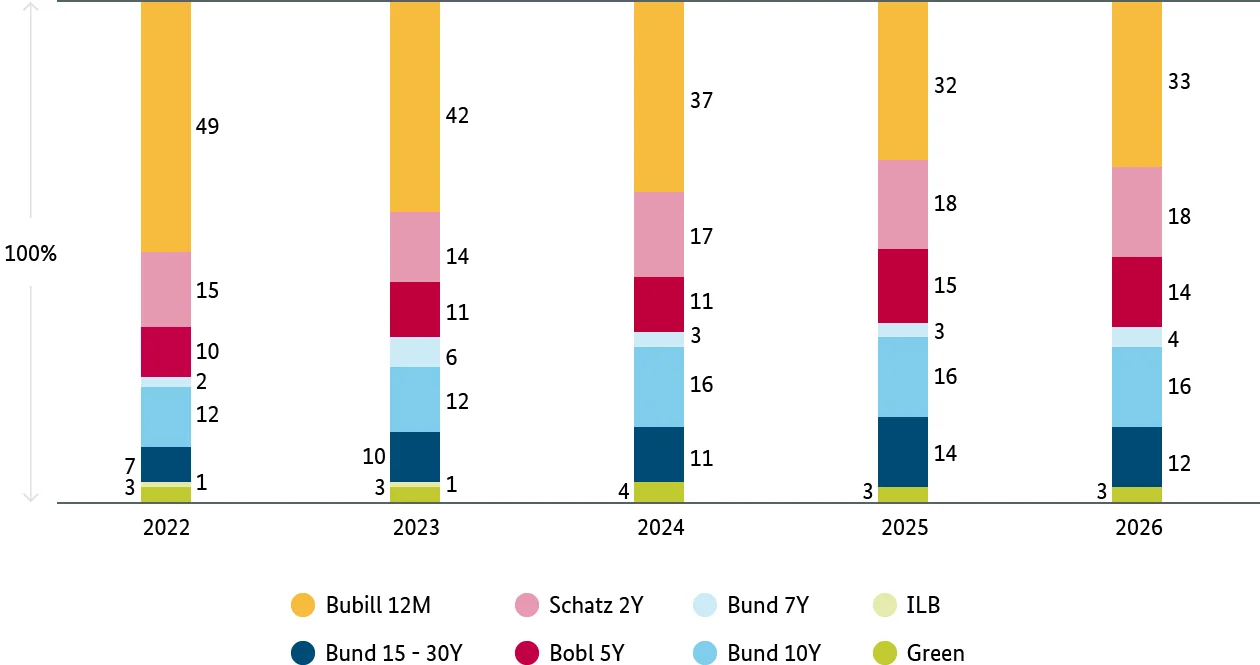
The main instrument of borrowing is the issuance of Federal securities via an auction or tender procedure.
Members of the Bund Issues Auction Group initially take the offered Federal securities into their own portfolios and then gradually resell them to their customers.
The Federal government also uses the syndicate procedure for the issuance of Federal securities, but comparatively less frequently. When issued via a syndicate, the respective Federal securities are brokered directly to investors on behalf of the Federal government by a selected group of banks for a fee.
The Federal government's planned issuance program is announced as an annual forecast at the end of the previous year for the following calendar year. A detailed issuance calendar with exact auction dates is published in order to provide investors with the greatest possible planning certainty.
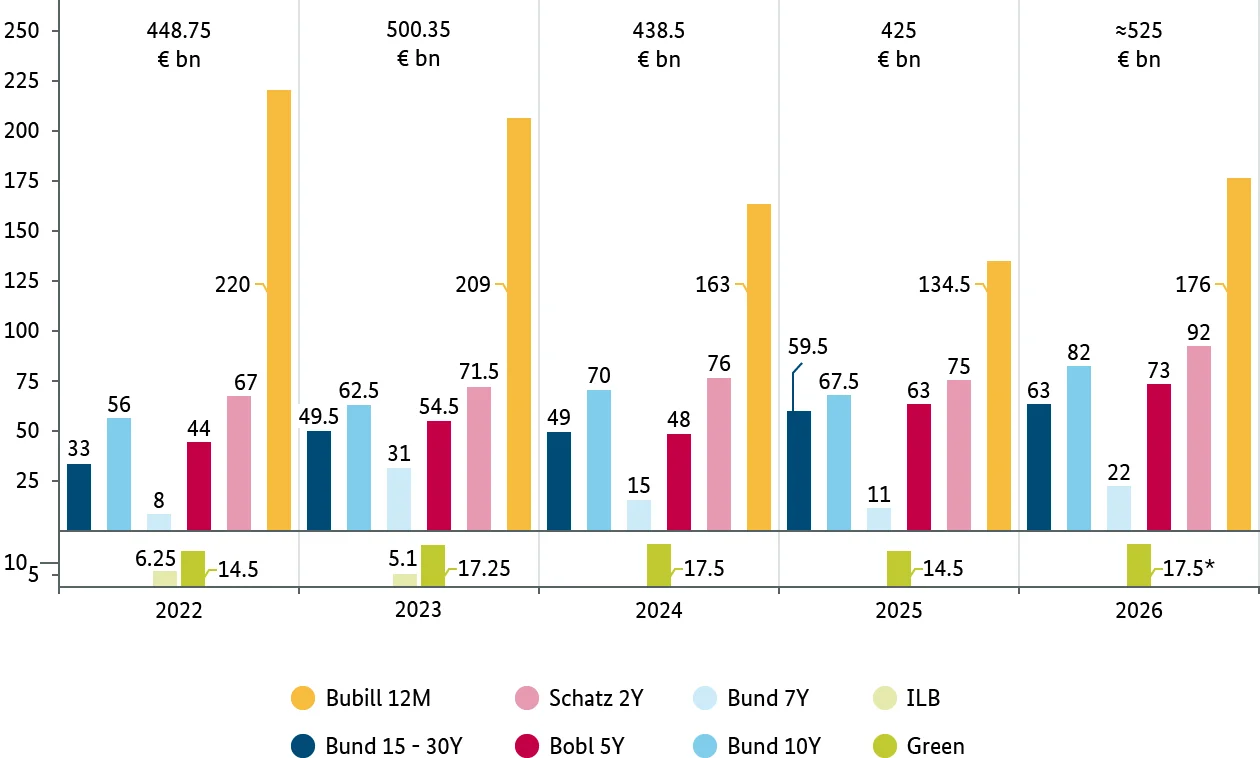
Recent years have been marked by international crises, to which the German government has responded with aid and investment programmes. The Covid-19 pandemic in 2019, the start of Russia’s war against Ukraine in 2022, and the resulting energy crisis and need for investment to boost defence capabilities and to stimulate the economy have led to a significant increase in borrowing requirements.
Borrowing requirements that were uncertain in terms of both timeframe and amount – such as those arising from Covid-19 measures – were primarily financed through the issuance of short-term securities, such as Bubills. By contrast, the expenditure under the Fiscal Pact, which is fixed in total and spread out over time in the financial plan, has so far been financed to a significantly greater extent through medium- to long-term Federal securities.